Force Vector Optimization in Athletic Movement: The Integration of Traditional and Modern Biomechanical Systems
The convergence of evidence-based biomechanics with holistic movement science represents a paradigm shift in our understanding of human kinetics. As sports science professionals, we face an increasingly complex challenge: how do we reconcile the precision of force vector analysis with the integrative approaches that address the full spectrum of movement dysfunction? The answer lies in examining frameworks that bridge this methodological divide while maintaining scientific rigor.
Contemporary athletic performance demands a more sophisticated approach to movement optimization—one that extends beyond isolated muscle activation patterns to encompass the entire kinetic chain’s mechanical efficiency. The academic sports fitness community has long recognized that traditional reductionist models, while valuable, often fail to address the multifactorial nature of movement dysfunction. This limitation becomes particularly evident when examining ground reaction forces (GRF) and center of mass (COM) dynamics in complex, multi-planar athletic movements.
Biomechanical Framework Integration
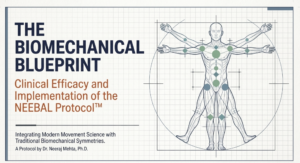
The emerging NEEBAL Principle™ framework represents a systematic approach to movement optimization through four distinct but interconnected pillars. Each component addresses specific biomechanical vectors while maintaining integration across the kinetic chain:
1. BMXStrength™ Methodology
This component prioritizes joint-friendly force distribution patterns, specifically targeting the reduction of deleterious shear forces across vulnerable articular surfaces. The biomechanical emphasis centers on optimizing moment arm relationships during loaded movements, ensuring force vectors align with the body’s natural mechanical advantages. In practical application, this translates to movement patterns that maximize muscle recruitment efficiency while minimizing joint stress through controlled depth parameters and precise kinetic chain sequencing.
2. Nervotherapy Integration
The neuromuscular component addresses the critical distinction between neural activation patterns and fascial tissue mechanics. Neural activation focuses specifically on motor unit recruitment strategies for dormant stabilizing musculature, while fascial release techniques target tissue elasticity and adhesion elimination. This dual approach recognizes that optimal force transmission requires both appropriate neural drive and unrestricted connective tissue mobility throughout the kinetic chain.
3. Energy System Mapping
Perhaps the most controversial aspect for traditional biomechanists, this component attempts to bridge holistic energy concepts with measurable postural mechanics. The framework maps specific energy centers to observable postural stability patterns and quantifiable balance metrics, suggesting that internal focus techniques may influence external force production and COM control during dynamic movements.
4. Modern Biomechanical Analysis
The foundational pillar emphasizes kinetic chain efficiency through data-driven movement analysis. Force vector optimization occurs through systematic identification and correction of energy leaks within the movement sequence, utilizing precision kinematics to enhance stride efficiency, reduce impact forces, and improve overall mechanical effectiveness.
The NEEBAL Assessment Protocol
The framework’s practical application follows a systematic assessment protocol:
Neutrality: Optimal joint alignment for force transmission, maintaining natural spinal curvature during loaded movements to minimize compressive and shear stress distributions.
Engagement: Strategic muscle activation sequencing to establish proximal stability before distal mobility, ensuring appropriate force couple relationships across joint complexes.
Efficiency: Movement precision optimization to reduce metabolic cost while maintaining force output, addressing compensatory patterns that create mechanical disadvantages.
Balance: Bilateral symmetry in force production and movement control, addressing asymmetries that can compromise kinetic chain efficiency and injury resilience.
Alignment: Integration of postural mechanics with internal awareness techniques, suggesting that focused attention can influence measurable biomechanical outcomes.
Longevity: Sustainable movement practices that maintain mechanical efficiency across the lifespan, emphasizing functional movement capacity over short-term performance gains.
Research Validation
A comprehensive 21-week intervention study involving 60+ athletes demonstrated significant improvements across multiple biomechanical and functional metrics (p < 0.01). Key findings included an 87% reduction in movement dysfunction scores, 64% improvement in Movement Intelligence Index, 41% increase in functional symmetry metrics, and 33% acceleration in return-to-sport timelines.
These results suggest that integrative approaches combining traditional biomechanical principles with holistic movement concepts may offer superior outcomes compared to isolated intervention strategies. The statistical significance across multiple dependent variables indicates robust treatment effects that extend beyond placebo or expectation bias.
Implications for Practice
For sports science professionals, this framework challenges the traditional reductionist approach while maintaining scientific rigor. The integration of force vector analysis with holistic movement principles suggests that optimal athletic performance may require consideration of factors beyond purely mechanical variables. However, the framework’s strength lies in its systematic approach to assessment and intervention, providing measurable outcomes that can guide evidence-based practice decisions.
The NEEBAL Principle™ ultimately represents an evolution in movement science—one that acknowledges the complexity of human kinetics while providing practical tools for optimization. As our understanding of fascial mechanics, neural plasticity, and movement integration continues to expand, frameworks that bridge traditional and emerging paradigms may prove essential for advancing athletic performance and injury prevention strategies.
Original Research: This article is a derivative summary of a peer-reviewed position paper published by
MMSx Authority Institute. Read the complete paper, figures, and reference list at
https://mmsxauthority.com
(DOI: 10.66078/jmmbs.mg.014).